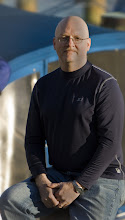
What is art? In my humble opinion art is anything that you like to look at. Having said that, as a painter, or sculpter or photographer if you see something someone else has done, is it ok to repeat it, as long as you don't try to claim it as your own original artwork? For instance, in this months issue of Rangefinder magazine, there's an image of Barack Obama similar to the one you see here. I (nor the other photographer) invented back lighting, the camera, or portrait photography. So if I like the effect, and reproduce it using my son as a model, did I plagerise the technique, or because the other photographer actually invented nothing new, is it all right? I guess it's subjective.
Wednesday, January 13, 2010
What is art? In my humble opinion art is anything that you like to look at. Having said that, as a painter, or sculpter or photographer if you see something someone else has done, is it ok to repeat it, as long as you don't try to claim it as your own original artwork? For instance, in this months issue of Rangefinder magazine, there's an image of Barack Obama similar to the one you see here. I (nor the other photographer) invented back lighting, the camera, or portrait photography. So if I like the effect, and reproduce it using my son as a model, did I plagerise the technique, or because the other photographer actually invented nothing new, is it all right? I guess it's subjective.


Wednesday, December 9, 2009
In the beginning there was light, and the light was good....so we used it for photography...A lot of beginners in the photography world don't know how to discern the "must haves" from the "really should haves", but if you don't, try this. Alien Bees lights come in several ranges: 400, 800, and 1600. They are very affordable with an excellent customer service record, and are inexpensive strobes, which differ from constant lighting in that they are usually brighter, but because they're not on all of the time, produce less heat. The other dilemma of the Alien Bees are that the light isn't as consistent as some discerning photographers would like, but many (such as myself) use them and are happy with the results! They range in the $200-$400 RANGE, WHICH IS ACTUALLY INEXPENSIVE IN THE WORLD OF PHOTOGRAPHY. I own the 400 and a reflector, and so far they've done all that I've needed. I also own 3 light stands with 3 shoot through umbrellas and brackets that connect them all together, and 3 flashes. I can put a flash on a light stand with a shoot through umbrella and make an outside lighting set up that will accomplish a lot. I buy most of my equipment at B&H, and Alien Bees....including my remote flash triggers. It's not very interesting usuually to light everything evenly, as it tend to be less drama in the scene...shadows can be good...as long as they're controlled.
Monday, December 7, 2009
It's all in the details...

I have had the pleasure recently to work with several models of different skill levels, and thought I'd share some things I've learned the hard way.
- Take a moment before taking the first shot to scrutinize the model closely.
- Take a moment before taking the first shot to scrutinize the model closely.
It was so important I put it twice, that's NOT a typo or a mistake. Check the eye liner and mascara, does it need to be touched up? Is it smeared? Are there chips in the nail polish? Does he/ she look as though they've been awake for a week straight? Is his/her hair EXACTLY right? Does he/she need to brush it or comb it? Is it dirty?Are they wearing jewelry that doesn't appear to belong in the images you want to take? Are their clothes wrinkled or dirty?
All of these things are going to cost you hours of retouching in Photoshop and it only takes a minute or two to go over the model's appearance. Also, take a moment before you actually take the first shot to look around the edges of the frame to make sure there's nothing there that doesn't belong, as well as behind the subject for distractions.
Then you ready the first shot. Do they appear afraid or nervous? This will transpose to the images you take as well. Take some time to help them relax and put them at ease, after all, this is a joint effort, affecting both of your careers (possibly). Once they're relaxed and posed, take another minute to look closely. Is there lint on their clothes? Are there unnatural folds in their skin? Even thin people can have skin folds, after all. Once it's as close to perfect as you can get, THEN actuate the shutter. Trust me, you'll still find things to edit in the post processing, but this will save you valuable time (after all, time is money!) later, when you have the time to REALLY scrutinize the images, and you'll have a lot more "keepers".
Saturday, November 14, 2009
Point of View and my site


First of all, let me say that after ordering Adobe Dreamweaver for Dummies, and registering a domain name as well as having someone host my site that I'm finally getting a web site going! It's not easy (at least for me), but if you'd like to check it out, click here.
Ok, on to the good stuff....point of view (hereafter I'll shorten this term to "POV") is literally what you're seeing, and from what angle. You may not realize it, but all of your life, you've seen things from a certain POV, whether you're sitting or standing or laying down. Why is this important, you may ask? As a photographer, images of animals or children especially look unflattering or boring if taken from a standing position. Get on your knees, or better yet, lay down! You'll find that this POV creates a much more dynamic (say interesting) image. It can also help the subject to interact in a way that wouldn't have been possible if you were standing.
Even if you're trying to capture a landscape, often a different POV can make all the difference!
Tuesday, October 6, 2009
Preparing for the eventuality that "STUFF" happens
As a photographer, you have to have redundant equipment so that when (notice I didn't say "if"?) something goes wrong, equipment fails, or you simply forgot to pack everything into your equipment bag, you won't have to run home and make the client/ subject wait. As well as seeming unprofessional, it wastes everyones time (and perhaps good light). The items that seem to have the most problems are flashes, and the accompanying cables, hot shoe adapters, etc...that go along with lighting the scene. I have known photographers who have forgotten to bring memory cards (me!) as well as the camera to a shoot. We're still human, after all...
So, having frightened you with the "what ifs", now to move on the what do I do to make sure this doesn't happen to ME! First of all, don't ever assume the batteries are charged, charge them every time. Have an extra set of batteries, in case the shoot is so magically delicious, you enter into a shooting frenzy, and use up a set. Have an extra COMPLETE set of cables, hotshoes, and recievers for wireless triggers, along with a 15 foot cable in case your wireless system goes on the fritz during a shoot. One light is still better off camera than having to use on camera flash.
Remember, it's not a question of "if", it's a question of "when".
So, having frightened you with the "what ifs", now to move on the what do I do to make sure this doesn't happen to ME! First of all, don't ever assume the batteries are charged, charge them every time. Have an extra set of batteries, in case the shoot is so magically delicious, you enter into a shooting frenzy, and use up a set. Have an extra COMPLETE set of cables, hotshoes, and recievers for wireless triggers, along with a 15 foot cable in case your wireless system goes on the fritz during a shoot. One light is still better off camera than having to use on camera flash.
Remember, it's not a question of "if", it's a question of "when".
Thursday, September 10, 2009
Michelle

Michelle, originally uploaded by Artistic Endeavors.
Taken using an AlienBee800 and a small shoot through umbrella. Straining the battery at full power because I'm in a battle to achieve a balanced exposure over powering the sun. It was getting fairly bright in the sky, so this was closer to the end of the sunrise shoot that morning. The interesting thing about this was....I moved the light very little...as long as I always placed the model in the same spot (they can wander if you're not watching them closely). Put the light so I'm not shooting dead on, and made sure I got the proper exposure on her face, not allowing her to become a sillouhuette. I was fairly golden. The sunlight causing the highlight in her hair was just icing on the cake.
Tuesday, September 8, 2009
Sherita and the beach (or a tale of a light and a battery)

The idea for this pose was found in a magazine. The models name is Sherita and it was taken 9/05/2009 at the ocean.
To say she was a pleasure to work with would be an understatement.
I used a battery source similar to this
 and a small shoot through umbrella with an Alien Bee 800, set at 1/2 power if I remember correctly. A small umbrella was used to modify the light, and she's backlit by good old Mr. Sun. I handheld the camera, as I'm prone to do on beach shoots, usually because I've almost always got enough light to be able to so. I've learned (Thank you Will King!) that before the sun is too far past the horizon, it takes less FLASH to overcome it. As the sun draws past the level of the horizon, it takes more and more FLASH to overcome it, until you lose the balance of light ratios and the Sun becomes brighter than your flash can compensate. Believe me, you don't want to be shooting at noon in the sun! That's unless you have a scrim, which if I needed more modifying I would have someone hold to softewn the suns rays shining on her. In hindsight, a scrim may have prevented the hot spot on her cheek. I do the do-it-yourself way with a frame made of PVC and elbows from the local hardware store, and a Wally World white cotton single flat sheet and some velcro tape. That scrim would also be a way to bounce light as a reflector, but since it's unyielding, you can't shape it, as you can do with a real reflector. In the modern day of Digital Photography, I have to agree with other photographers, that you can look at the LCD screen and tell if you "got it". Just make sure to zoom in to verify focal sharpness.
Subscribe to:
Posts (Atom)